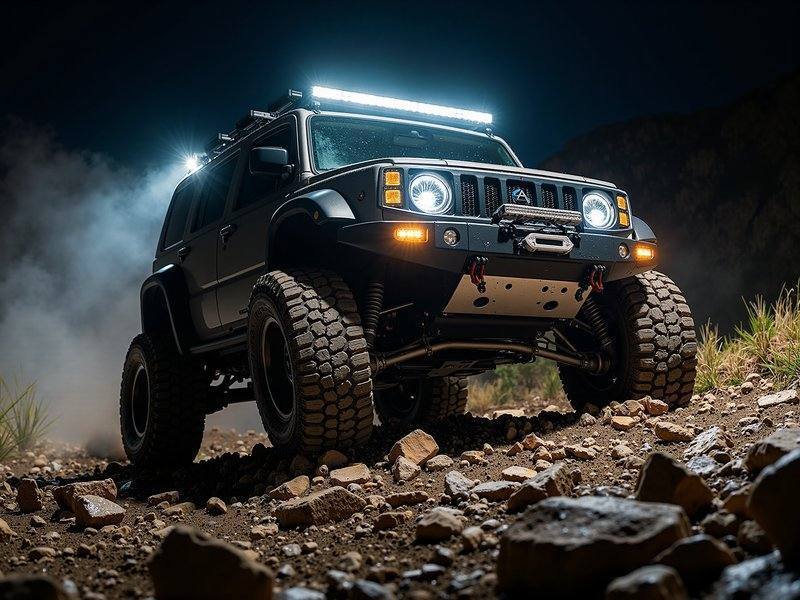
The curved vs straight LED light bar debate is one of the most common questions procurement teams and off-road builders face when spec'ing a new product line. The wrong choice ruins beam coverage, wastes housing tooling spend, and creates customer returns. This 2026 guide compares both designs across beam pattern, fitment, mounting, brightness efficiency, IP durability and OEM tooling cost — with factory benchmarks from a genuine IATF 16949 LED light bar manufacturer.
Curved vs Straight LED Light Bar: Quick Comparison
| Spec | Curved | Straight |
|---|---|---|
| Beam shape | Wider lateral spread | Concentrated forward throw |
| Mounting | Wraps around windshield / A-pillar | Flat roof rack / bull bar |
| Fitment | Vehicle-specific | Universal |
| Housing tooling | Higher (curved extrusion) | Lower (straight extrusion) |
| Lumens per dollar | Slightly lower (more reflector loss) | Slightly higher |
| Best use | Scene / wide cornering | Long-distance spot |
| Aurora part availability | 10"–50" curved | 7"–50" straight |
Aurora benchmark: Both shapes share the same IATF 16949 manufacturing process in Aurora's 35,000㎡ factory — 6 automated SMT lines, 1,000,000+ pcs/month capacity, genuine Osram/Luminus lot-traceable chips, IP68/IP69K sealing, 50,000+ hour lifespan and brightness up to 50,000+ lumens. Tooling difference is the housing extrusion, not the LED engine.
Beam Pattern: Why Curved Spreads Wider
The defining difference in the curved vs straight LED light bar decision is beam pattern. A straight bar mounts all LEDs on a single flat plane, so every reflector throws light forward on the same axis — producing a tight, concentrated spot or combo beam that reaches further down a trail. A curved bar places LEDs along an arc (typically 10°–30° depending on length), so the outer LEDs angle slightly outward. This widens the lateral spread, lighting up the shoulders and ditches without moving the bar.
For high-speed desert running where you need to read terrain 300m ahead, a straight spot beam wins. For slow technical trail work, hunting, or worksite flood lighting where 180° scene coverage matters more than distance, a curved bar wins. Most 4x4 owners actually benefit from a hybrid: a curved 50" bar on the windshield for scene lighting, paired with a straight 20" spot on the bull bar for distance.
Aurora tunes both shapes with custom reflectors in-house — beam pattern is locked at the photometric lab before mass production, so every batch ships to the same intensity distribution. This is the difference between a factory that designs beam optics vs one that assembles catalog housings.
Fitment And Mounting: Curved Matches The Vehicle
A straight bar is a universal flat extrusion — it mounts to any flat surface: bull bar, roof rack, headache rack, bumper. This is why straight bars dominate the aftermarket accessory market. A curved bar is shaped to match the arc of a specific vehicle's windshield or A-pillar, so it sits closer to the glass, looks integrated, and reduces wind noise at highway speed. The trade-off: curved fitment is vehicle-specific. A 50" curved bar tuned for a Ford Raptor windshield will not sit flush on a Jeep JK.
For OEM programs, this matters enormously. If you are building a vehicle-specific accessory line, curved housings let you offer a factory-fit look that justifies premium pricing. If you are building a universal catalog for distributors, straight housings cover 90% of vehicles with one SKU. Aurora's 40-engineer R&D team runs CAD fitment verification for every new curved housing, with 500+ pcs MOQ for new tooling — the realistic threshold for a vehicle-specific program.
Brightness, Efficiency And Lumens Per Dollar
A common claim is that curved bars "lose lumens" due to reflector angle losses. In practice, the loss is small — typically 3–7% vs a straight bar of the same length and chip count, because the outer reflectors are angled rather than perpendicular to the road. The real brightness question is the LED chip itself. A genuine Osram or Luminus chip produces 50,000+ hour lifespan and stable lumen output; a relabeled or reclaimed chip loses 30–50% brightness within the first 200 hours.
Aurora uses only genuine Osram/Luminus chips, every chip lot-traceable to the original purchase invoice, with brightness up to 50,000+ lumens on flagship dual-row bars. The 3–7% reflector loss on a curved bar is dwarfed by the chip quality variable — which is why specifying chip traceability matters far more than the housing shape in your OEM RFQ.
Durability: Both Shapes Share IP68/IP69K
Durability is where the curved vs straight debate dissolves — both shapes face the same environment. Off-road means river crossings (IP68 continuous immersion to 1.5m), high-pressure mud cleaning (IP69K high-pressure 80°C water jet), salt spray corrosion (Aurora tests to 480+ hours), thermal cycle from -40 to +85°C, and vibration from corrugated dirt roads.
A genuine factory validates every one of these in-house — integrating sphere for lumens, photometric distribution for beam, salt spray chamber, thermal cycle chamber, vibration table, IP test tank. Aurora runs all of these in its 35,000㎡ Shenzhen facility with 6 automated SMT lines and 400+ staff. The housing shape does not change the IP rating; the sealing process does. Both curved and straight Aurora bars ship with IP68/IP69K sealing and a 50,000+ hour rated life.
OEM Tooling Cost And MOQ Reality
The practical OEM question: what does each shape cost to launch? A straight bar uses a straight aluminum extrusion that can be cut to any length from one master die — so the housing tooling is shared across the entire 7"–50" straight range. A curved bar needs a curved extrusion die per curvature radius, so each curvature (and each length) may require its own tooling.
This is why most factories quote 500+ pcs MOQ for curved custom tooling and 100 pcs MOQ for straight custom branding. Aurora's standard MOQ is 100 pcs for straight bars with custom branding, 500+ pcs for new curved tooling. Lead time is 20–25 days for standard and 30–40 days for bulk — the same whether the bar is curved or straight, because the SMT, assembly, sealing and testing processes are identical.
Frequently Asked Questions
Is a curved or straight LED light bar better for off-road use?
It depends on beam need. A straight bar throws a tighter, longer spot beam — better for high-speed trail running. A curved bar spreads light wider laterally — better for scene lighting, slow technical trails and worksite flood. Many builders run both: curved 50" for scene, straight 20" for distance.
Does a curved LED light bar lose brightness?
Only marginally — typically 3–7% vs a straight bar of equal length and chip count, due to outer reflector angling. Chip quality matters far more than housing shape: a genuine Osram/Luminus chip produces stable output for 50,000+ hours, while a relabeled chip loses 30–50% brightness within 200 hours regardless of housing shape.
Can I get a custom curved LED light bar with my own logo?
Yes. Aurora's standard MOQ is 100 pcs for straight bars with custom branding and 500+ pcs for new curved tooling. Lead time is 20–25 days for standard runs and 30–40 days for bulk. Customization includes PCB, beam, bezel, connector and packaging — not just logo printing.
Why do curved light bars cost more than straight ones?
Because each curvature radius and length typically requires its own aluminum extrusion die, vs a single master die that can be cut to any straight length. The LED engine, SMT process, sealing and testing are identical, so the cost difference is the housing tooling amortization, not the electronics.
Get A Factory Quote
If you need a certified IATF 16949 LED light bar manufacturer for your curved or straight program, Aurora's engineering team responds within one business day. Request a quote or explore our off-road LED light factory.