Picking the wrong led light bar size is the most common mistake in off-road lighting sourcing. Too small and you under-light the trail; too big and you fight mounting fitment, alternator load, garage door clearance, and local road regulations. This 2026 sizing guide walks through what size light bar you actually need — from 7" to 50" — based on beam need, vehicle fitment, electrical system, and OEM tooling reality.
Skip to FAQ · Request a quote from Aurora
LED Light Bar Size Chart
| Length | Typical beam | Best mounting | Use case | Amp draw (12V) |
|---|---|---|---|---|
| 7" | Spot/combo | Bull bar / lower bumper | Distance, low mount | ~3–5A |
| 10" | Spot/combo | Bull bar / grille | Distance, low mount | ~5–7A |
| 20" | Combo/spot | Bull bar | Most popular — distance + peripheral | ~8–10A |
| 30" | Combo | Roof rack / windshield | Mixed trail | ~12–15A |
| 40" | Combo/flood | Windshield (straight) | Mixed trail + scene | ~16–18A |
| 50" | Flood/scene | Windshield (curved) | Full scene coverage | ~18–22A |
Aurora benchmark: Aurora manufactures every size from 7" to 50" in both straight and curved housings in its 35,000² Shenzhen factory — 6 automated SMT lines, 1,000,000+ pcs/month capacity, genuine Osram/Luminus lot-traceable chips (50,000+ hour lifespan, up to 50,000+ lumens), IP68/IP69K sealing, 480+ hour salt spray, -40 to +85°C thermal cycle, IATF 16949/DOT/E-Mark/CE/RoHS. A genuine led light bar manufacturer.
Sizing Factor 1: Beam Need Drives Size First
The first sizing question is not "what fits my truck" — it is "what beam do I need." A 50" flood bar on the windshield throws wide scene light but no useful distance; a 7" spot on the bull bar throws distance but no peripheral. Pick the beam role first, then the size that delivers it.
For high-speed trail running where you need 300m+ of forward visibility, a 20" single-row spot on the bull bar is the gold standard. For mixed trail riding, a 20" combo covers 80% of needs. For full scene coverage at camp or worksite, a 40"–50" flood or curved bar is the right call. Many serious 4x4 builds run two bars: 20" combo on the bumper, 50" flood on the windshield — each sized to its beam role.
Sizing Factor 2: Vehicle Fitment Limits Length
A light bar that does not fit the vehicle is a 100% warranty event. The rule of thumb sizing:
- Bull bar / lower bumper — typically up to 20"–30" maximum, depending on the bull bar width. Most bull bars fit a 20" bar cleanly.
- Roof rack / headache rack — 30"–50", depending on rack width. A 40" bar fits most full-size truck racks.
- Windshield mount (straight) — up to 40" on full-size trucks. Larger and the bar typically interferes with sunroof or roof line.
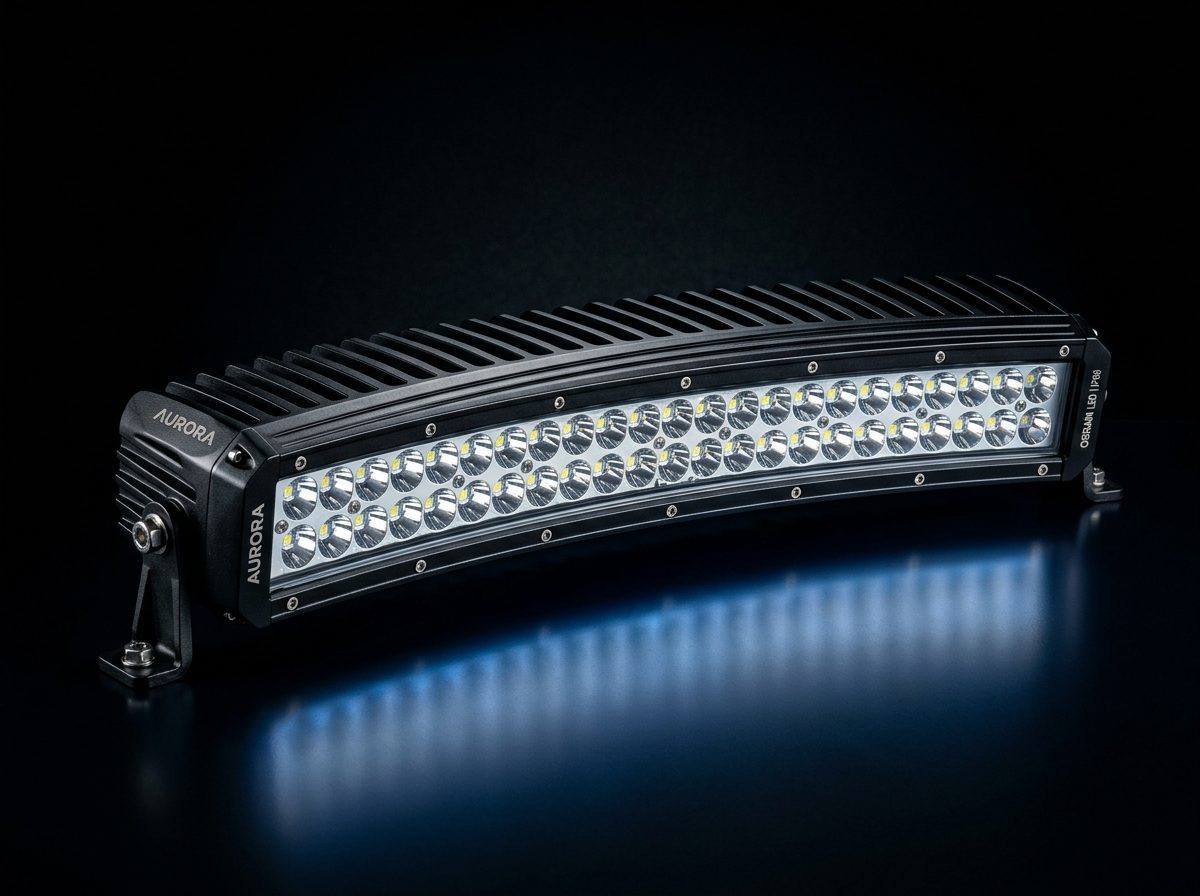
- Windshield mount (curved) — 50" is the standard show-build size, fit-matched to the vehicle windshield arc.
For OEM vehicle-specific accessory programs, fitment is a CAD problem solved before tooling. Aurora's 40-engineer R&D team runs CAD fitment for every new curved housing, with 500+ pcs MOQ for new tooling.
Sizing Factor 3: Electrical System Sets The Ceiling
Bigger bars draw more current. A 50" dual-row bar at 12V can draw 18–22A — fine for a modern truck with a 150A alternator, but a problem for an ATV, UTV, or small-displacement 4x4 with a 40–60A alternator. At idle, with headlights, fan, and ECU already drawing, a 20A light bar load can pull system voltage below the low-voltage cutoff on a small alternator.
Aurora's operating voltage range covers 9–36V (12V vehicle systems) and 10–60V (mixed 12/24V applications — trucks, agricultural equipment, mining). The constant-current driver includes protection against load dumps, reverse polarity, and over-voltage per IATF 16949 automotive standards. Specify your vehicle's electrical system in the OEM RFQ so the driver is matched to the application.
Sizing Factor 4: Local Road Regulations Limit Length
Many jurisdictions limit the maximum width of auxiliary lighting on road-registered vehicles. In some US states, a bar wider than 40" must be covered when on public roads. In most ECE member states, any auxiliary light above the headlights must be wired through the high-beam circuit and cannot exceed a defined luminous intensity. A 50" bar at 22,000+ lumens is well above ECE on-road limits in most jurisdictions — which is why many 50" bars are labeled "for off-road use only."
If your product is going to a road-legal accessory market, the practical maximum is often 30"–40". If your product is going to a pure off-road / show build market, 50" is the ceiling. Aurora ships E-Mark approved bars under ECE R10 for road-legal applications and clearly labels off-road-only bars where appropriate.
Sizing Factor 5: OEM Tooling And MOQ Reality
| Program type | MOQ | Lead time | Tooling |
|---|---|---|---|
| Standard size, custom branding | 100 pcs | 20–25 days | Stock housing |
| Custom length on stock extrusion | 100–500 pcs | 20–25 days | Cut to length |
| Custom curved housing, new tooling | 500+ pcs | 30–40 days | New extrusion die |
| Fully custom reflector / beam | 500+ pcs | 30–40 days | New reflector tooling |
| Bulk production run | 5,000+ pcs | 30–40 days | Production-scale |
A factory offering "any size, 1 pc MOQ, full customization" is almost always a trading company. A genuine factory like Aurora supports 100 pcs standard MOQ with custom branding on stock housings, and 500+ pcs for new tooling — transparent lead times you can plan a product launch around.
FAQ
What size LED light bar should I get?
A 20" combo on the bull bar is the most popular and practical size — covers 80% of night trail needs without blocking airflow or interfering with the sunroof. For full scene coverage at camp or worksite, a 40"–50" flood or curved bar. For high-speed desert running, a 20"–30" single-row spot.
Will a 50 inch light bar fit my truck?
A 50" curved bar fits the windshield arc of full-size trucks (Ford Raptor, Chevy Silverado, RAM 1500) when fit-tuned to the specific vehicle. A 50" straight bar fits a full-size truck roof rack. Smaller trucks, SUVs, and crossovers usually max out at 30"–40".
How much power does a LED light bar use?
A 20" combo typically draws 8–10A at 12V (~120W). A 50" dual-row can draw 18–22A at 12V (~240W). Modern trucks with 150A+ alternators handle this easily; ATVs, UTVs and small 4x4s with 40–60A alternators may struggle at idle.
What is the legal maximum LED light bar size for road use?
Most jurisdictions limit auxiliary lighting width to 40" on road-registered vehicles, and require the bar to be wired through the high-beam circuit and covered when not in use. ECE member states enforce intensity limits above the headlight line. A 50" bar at 22,000+ lumens is typically off-road-only.