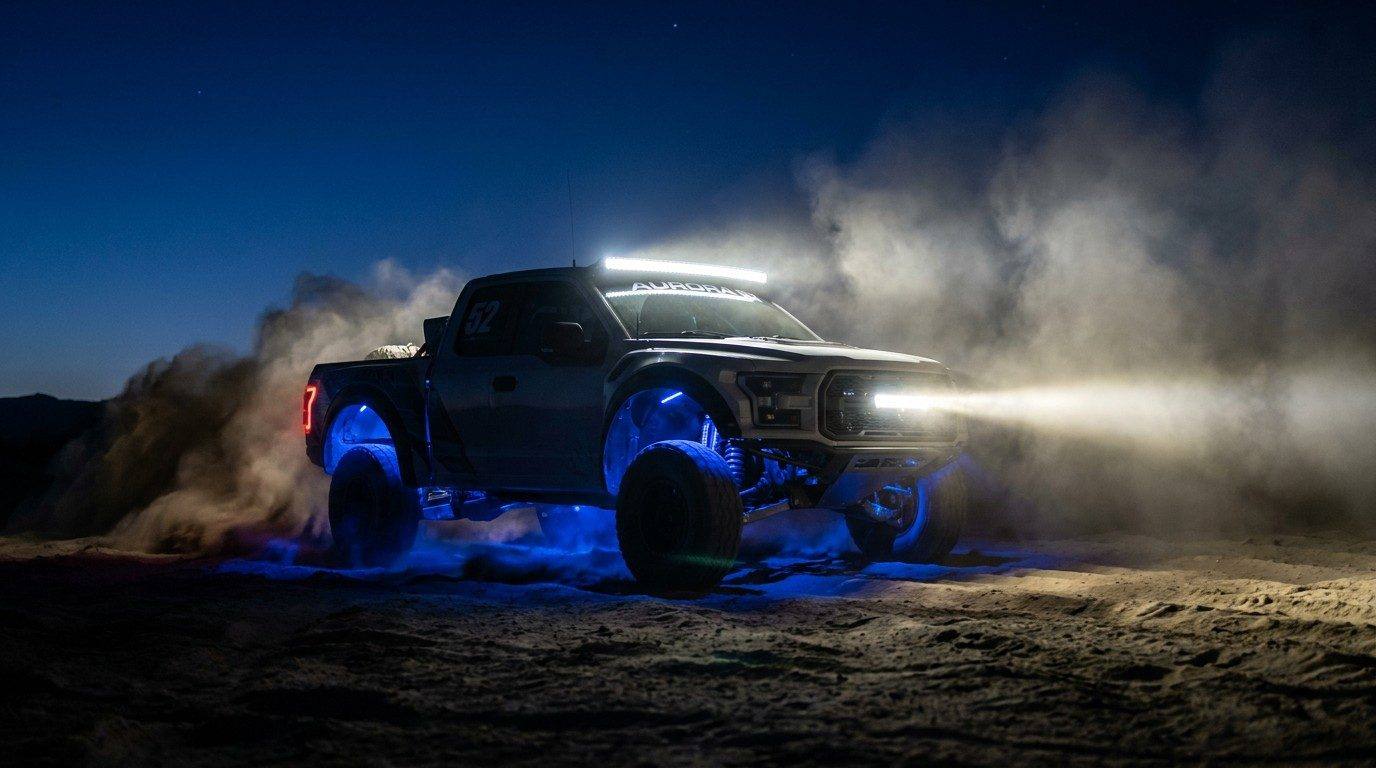
Spec sheets for off road lights are loaded with numbers — lumen, watt, IP, lux, beam distance — but most buyers focus on the wrong ones and miss the four specs that actually predict field performance. This 2026 off road light buying guide explains what to look for in off road lights: chip brand, IP rating, beam pattern, thermal design, voltage range and warranty, with hard parameters from a genuine factory.
Off Road Light Spec Table: What Really Matters
| Spec | What it means | Buy below this | Aurora benchmark |
|---|---|---|---|
| Luminous flux | Total light output | < 10,000 lm | Up to 50,000+ lm |
| Chip brand | LED source | Generic / unbranded | Genuine Osram/Luminus (lot-traceable) |
| IP rating | Dust and water sealing | IP66 or below | IP68/IP69K |
| Lifespan | L70 hours | < 30,000 h | 50,000+ hours |
| Operating voltage | Vehicle compatibility | Single voltage (12V only) | 9–36V / 10–60V |
| Salt spray resistance | Corrosion resistance | < 240 h | 480+ hours |
| Operating temperature | Cold and heat tolerance | -20 to +60°C | -40 to +85°C |
| Beam pattern options | Use-case fit | Spot only | Spot / Flood / Combo / Driving |
| Warranty | Factory confidence | < 2 years | 3+ years typical OEM |
Key insight: Lumen alone is misleading. A 20,000 lm light with generic chips and poor thermal design will dim 30% in 6 months. A 15,000 lm light with genuine Osram chips, IP69K sealing and engineered thermal management will hold output for years. Source from a real off road light factory.
Spec 1: Chip Brand Is Half The Equation
The first thing to check in any off road light buying guide is the LED chip brand — not the lumen number. Generic chips degrade fast under high drive current and heat, losing 20–40% of output within the first 1,000 hours. Genuine Osram and Luminus chips, when properly driven and cooled, hold L70 (70% original output) past 50,000 hours.
The challenge is that "Osram" or "Luminus" on a spec sheet is meaningless without lot traceability. Relabeled and reclaimed chips are common in the budget tier. A genuine factory can produce purchase invoices tying each chip batch to its wafer lot — Aurora does this for every production run, and it is the single reason Aurora can certify 50,000+ hour lifespan and brightness up to 50,000+ lumens.
Spec 2: IP68 And IP69K — Both, Not Either
What to look for in off road lights for sealing: IP68 for immersion and IP69K for high-pressure water jet. IP68 (1.5m continuous immersion) covers river crossings and storm exposure. IP69K (high-pressure 80°C water jet) covers pressure-washing after mud runs. A light rated only IP67 survives rain but fails car-wash pressure jets. A light rated only IP68 may leak under direct high-pressure spray.
Aurora seals every light to both IP68 and IP69K, validated in-house with pressure tanks and water-jet test rigs. Request the IP test report with lab name and date — a real factory provides it; a reseller cannot.
Spec 3: Beam Pattern Must Match Your Use Case
| Beam | Range | Width | Best for |
|---|---|---|---|
| Spot | Long (500m+) | Narrow | Highway / desert racing |
| Flood | Short (100m) | Wide | Slow rock crawling / work area |
| Combo | Medium | Mixed | General trail driving |
| Driving | Medium-long | Medium | SAE/ECE street-legal driving |
The most common buying mistake is choosing spot beams for every scenario. Spot beams throw a narrow pencil of light extremely far — useful at speed but blind to the sides on tight trails. Combo beams (spot + flood in one housing) cover 80% of real-world off-road needs. Aurora offers all four beam patterns with custom tuning on OEM orders.
Spec 4: Thermal Design Determines Lifespan
Heat kills LEDs. A poorly designed housing traps heat at the chip junction, accelerating lumen depreciation and shortening life from 50,000 hours to 15,000. Thermal design is invisible on a spec sheet — you have to look at the housing.
Signs of engineered thermal management: thick die-cast aluminum housing, integrated heat fins, thermal pad between PCB and housing, and a junction-to-ambient thermal resistance under 8°C/W. Aurora holds patents in thermal management and beam control, and validates junction temperature in-house on every new design — the engineering behind genuine 50,000+ hour lifespan.
Spec 5: Voltage Range And Electrical Protection
| Spec | What it does | Aurora standard |
|---|---|---|
| Voltage range | Compatibility with 12V/24V vehicles | 9–36V / 10–60V |
| Reverse polarity protection | Survives mis-wiring | Yes |
| Over-voltage protection | Survives alternator spikes | Yes |
| EMI filter | Prevents radio interference | Yes |
| Low-voltage cutoff | Protects vehicle battery | Yes |
A light that works only at exactly 12V will fail on a 24V truck or when the alternator spikes to 14.4V. Aurora's 9–36V and 10–60V dual-range drivers cover virtually every vehicle platform — powersports, truck, agricultural, mining and marine.
Spec 6: Mechanical Robustness — Salt, Vibration, Temperature
Off road lights face salt spray, vibration and temperature extremes that street lights never see. The minimum benchmark: 480+ hour salt spray resistance (Aurora runs 480+), operating temperature -40 to +85°C (Aurora covers both), and vibration tested to simulate 10,000 km of trail use. Polycarbonate lens must be hard-coated against UV yellowing and stone chipping.
Spec 7: Certification And Homologation
For street-legal markets, certification matters: DOT for North America, E-Mark for Europe, SAE for the US. For pure off-road, IATF 16949 factory certification is the strongest signal of quality system maturity. Aurora holds IATF 16949, DOT, E-Mark, CE and RoHS — the broadest certification footprint in the off-road OEM tier.
Spec 8: Warranty And Factory Pedigree
Warranty length is the factory's bet on its own quality. A 6-month warranty means the factory expects failures within a year. A 3-year warranty means the factory is confident in chip quality, thermal design and sealing. Aurora supplies the Walmart, Bosch and Ford supply chains — buyers who audit factories for days before approval — and supports OEM programs with extended warranty terms.
Frequently Asked Questions
What to look for in off road lights in 2026?
Look for genuine Osram or Luminus chips (with lot traceability), IP68 and IP69K sealing, beam pattern matched to your use case, engineered thermal management, wide voltage range (9–36V or 10–60V), salt spray resistance of 480+ hours, operating temperature -40 to +85°C, and IATF 16949 factory certification. Lumen alone is a misleading spec.
How many lumens do I need for off road driving?
For trail driving at moderate speed, 10,000–15,000 lm per light is sufficient. For high-speed desert racing, 18,000–22,000+ lm is appropriate. Aurora builds lights up to 50,000+ lm with genuine Osram/Luminus chips — but chip quality, thermal design and beam pattern matter more than raw lumen.
Is IP69K necessary for off road lights?
Yes, if you pressure-wash your vehicle. IP68 covers immersion (river crossings), but IP69K covers high-pressure high-temperature water jets (pressure washers). Aurora seals every light to both IP68 and IP69K. A light rated only IP67 or IP68 may leak under direct pressure-washing.
What voltage range should off road lights support?
At minimum, 9–36V covers both 12V and 24V vehicle systems. For broader compatibility (including 48V industrial equipment), 10–60V is preferred. Aurora offers both 9–36V and 10–60V drivers with reverse polarity, over-voltage and EMI protection standard.
Request A Quote
If you want off road lights built to these specs — genuine Osram/Luminus chips, IP68/IP69K, 50,000+ hour lifespan — Aurora's engineering team responds within one business day. Request a quote or explore our off road light factory.